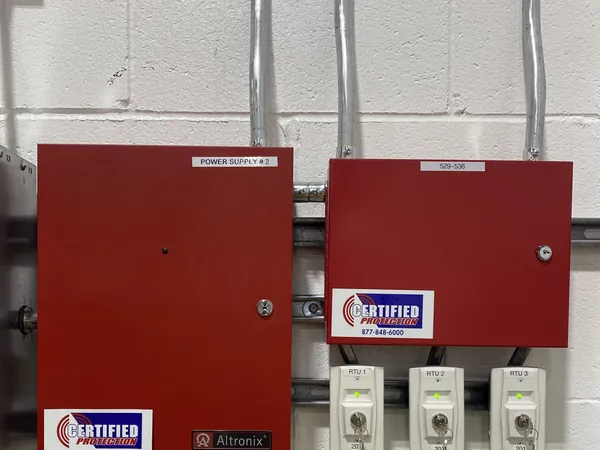
- The most common failure is the simplest one: batteries that can no longer carry the system for the required standby and alarm period.
- The second most common is paperwork. Inspectors ask for prior test records and as-built drawings, and a building that cannot produce them has a problem before anyone touches a device.
- Almost everything on this list is preventable between visits. Call 732-346-5333 for an inspection or a pre-inspection walk-through.
- Dead and Dying Batteries
- Records Nobody Can Find
- Devices That Got Painted, Blocked, or Buried
- Coverage That No Longer Matches the Building
- The Signal That Never Leaves the Building
- Everything Else Wired to the Panel
- Troubles the Panel Has Been Showing for Months
- How to Pass the First Time
- Questions People Ask
Dead and Dying Batteries
This is the number one finding, and it is not close.
A fire alarm system has to keep running when the building loses power. Under NFPA 72, the secondary power supply generally has to carry the system for 24 hours in standby and then 5 minutes in full alarm, and 24 hours plus 15 minutes where there is voice evacuation. Sealed lead-acid batteries lose capacity steadily whether or not they are ever called on, and the usual service life is three to five years.
The trap is that a weak battery looks perfectly fine. The panel shows normal, the green light is on, and the charger keeps a surface voltage that reads correctly on a meter. It fails under load, which is to say it fails the one time it matters and during the load test at inspection.
What gets written up:
- Batteries past their date code, which is printed right on the case.
- Batteries that pass a voltage check but drop out under load.
- Swelling, corrosion at the terminals, or leakage.
- Batteries that were replaced with the wrong amp-hour rating, so the system no longer meets its calculated standby requirement.
That last one catches people who had a handyman swap batteries to save a service call. The required size comes out of a battery calculation tied to the device load on that panel. Two batteries that physically fit are not necessarily the two batteries the system needs.
Records Nobody Can Find
An inspector shows up and asks for the file. A lot of buildings do not have one.
The documentation that gets requested is usually prior inspection and test records, the record of completion from the original installation, as-built drawings showing device locations, the battery calculation, and a list of corrections from the last visit with proof they were made. A building that cannot produce these is not automatically failing, but it starts the visit badly and it makes every other question harder to answer.
This gets worse with building turnover. The property changes hands, the management company changes, the maintenance supervisor retires, and the binder in the electrical room goes in a dumpster. Three years later nobody knows when the system was installed, who programmed it, or what the last contractor found.
The fix costs nothing. Keep a single file, digital is fine, with every report and every drawing revision. Any contractor worth using will send you one after each visit.
Devices That Got Painted, Blocked, or Buried
Buildings change between inspections and the fire alarm is rarely consulted first.
- Painted detectors and strobes. A crew repaints a corridor, masks nothing, and a smoke detector takes a light coat. It is now a failed device. Same for a strobe lens, which has an engineered light output that paint ruins.
- Blocked notification. New shelving, a hanging sign, a stack of pallets, or a partition in front of a horn strobe. The device works perfectly and reaches nobody.
- Pull stations behind things. A filing cabinet, a display, a coat rack. Pull stations have to be unobstructed and reachable.
- Storage against detectors. Common in warehouses, where stock gets stacked too close to the ceiling and changes how smoke reaches the device.
None of this requires a technician to catch. A walk of the building looking up, twice a year, finds most of it.
Coverage That No Longer Matches the Building
A fire alarm is engineered around a floor plan. When the floor plan changes and the system does not, the building drifts out of compliance quietly.
New walls that create rooms with no notification coverage. Lowered ceilings that throw off detector spacing. A storage room converted to an office. An area converted from office to assembly or medical, which changes the requirement outright. We wrote about this in detail in what happens to the fire alarm during a commercial renovation, and it is the single most expensive item on this list to fix after the fact.
Audibility and visibility get measured, not eyeballed. Notification has to be loud enough to be heard over the normal ambient noise in that space, which is why a warehouse with running equipment needs more than a quiet office of the same square footage. If production moved into a space that used to be storage, the devices that were adequate before may not be now.
The Signal That Never Leaves the Building
A monitored fire alarm is tested end to end, meaning the signal has to actually arrive at the central station and be acknowledged. This is where buildings get surprised.
The usual causes are a phone line that was disconnected or converted during a telecom change, a communicator that was never reprogrammed after the monitoring account changed hands, and an IP path that stopped working when the network was reconfigured and nobody connected the two events. We covered the bigger version of this in what the copper shutdown means for alarm systems, because phone carriers retiring copper lines is about to turn this from an occasional finding into a common one.
Worth understanding: a communication failure means that for however long it has been broken, the building had a fire alarm that makes noise locally and summons nobody. The inspection is often how it gets discovered.
Everything Else Wired to the Panel
The fire alarm panel usually does more than sound horns, and the extras are the most commonly skipped part of a cheap inspection.
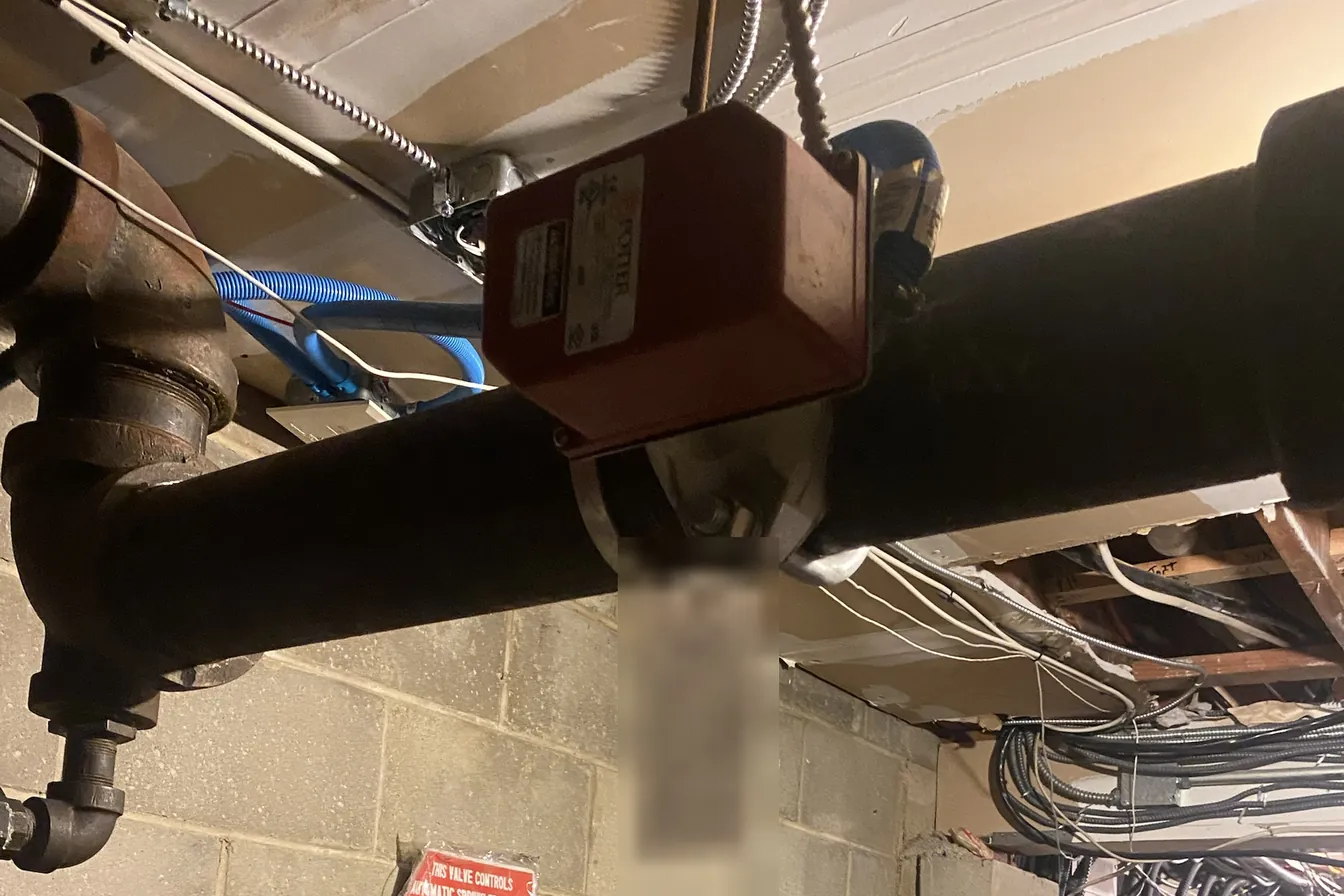
- Sprinkler supervisory devices. Waterflow switches and tamper switches on control valves report to the panel. A closed valve that nobody knows about is one of the worst conditions a building can have, and the tamper switch exists to prevent exactly that.
- Duct smoke detectors. They shut down air handlers so the HVAC system does not distribute smoke. They need to be accessible to test, and in a lot of buildings they are above a hard ceiling or behind equipment, which is its own finding.
- Elevator recall. Detectors in lobbies and machine rooms send cars to a designated floor. This gets tested with the elevator company, which means coordinating two vendors and is therefore the thing most likely to get postponed.
- Door holders and magnetic locks. Fire doors have to release and access-controlled egress doors have to unlock on alarm. Worth checking any time the access control system is modified.
If a quote for an annual inspection looks unusually cheap, this list is normally what is missing from it.
Troubles the Panel Has Been Showing for Months
Walk up to a panel and look at it. If there is a trouble light on, or a buzzer somebody silenced with tape over the sounder, the building has been running with a known fault.
Standing troubles usually mean a device is offline, a circuit has a ground fault or an open, or the communicator cannot reach the central station. Each of those is a finding on its own, and the fact that it has been ignored tends to shape how the rest of the visit goes.
Staff get trained to ignore the panel because it has been beeping for a year. That is the actual risk here, more than any individual fault. A panel nobody looks at is a panel that cannot tell you anything.
How to Pass the First Time
Thirty minutes of work ahead of the visit prevents most of this:
- Check the date code on the batteries. If they are more than four years old, replace them before the inspection rather than paying for a return trip.
- Look at the panel. Clear any standing trouble, or at least know what it is and tell the inspector.
- Find the file. Prior reports, drawings, the record of completion. If it does not exist, ask your contractor to rebuild it starting now.
- Walk the building looking up. Painted, blocked, or obstructed devices, and anything that changed since the last visit.
- List every renovation since the last inspection, even small ones, and say so up front.
- Confirm the monitoring account is current and ask for a communication test before the inspector is standing there.
- Coordinate the elevator company in advance if recall is part of the scope.
The broader point is that inspection frequency is set by code and your local official, covered in how often commercial fire alarms need inspection in NJ, but the condition of the system between visits is set by whoever is paying attention. Buildings on a real service agreement rarely fail, because the problems get found in February instead of on inspection day.
We inspect, test, and service commercial fire alarm systems across Edison, Woodbridge, Metuchen, New Brunswick, Piscataway, and Middlesex, Monmouth, Union, Somerset, Essex, and Morris counties. Call 732-346-5333 or use the form below.