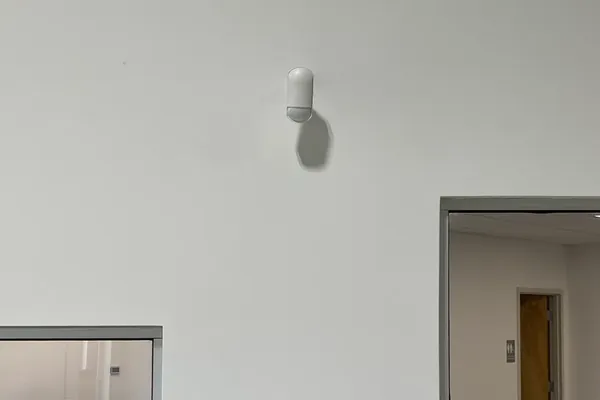
- Most businesses have the pieces: an alarm panel, some card readers, a few cameras. They were usually installed at different times by different companies, and the gaps between them are where losses happen.
- A secure building after hours needs three things working together: a monitored perimeter, interior motion detection placed where intruders actually walk, and access control that knows when a door is forced or left open.
- If the alarm and the card access system cannot talk to each other, that is the first fix. Call 732-346-5333 for a walk-through.
- Where Business Security Actually Breaks Down
- Motion Detectors: Placement Is Everything
- Door Contacts and Door Position Switches
- When Card Access and the Alarm Work as One System
- Exit Hardware on Doors You Want to Secure
- Partitions: Arm the Building in Sections
- Getting a Real Response
- Starting From What You Have
- Questions People Ask
Where Business Security Actually Breaks Down
When we review a business that had a break-in or an unexplained loss, the hardware is rarely missing. What we find are gaps between systems. The card access system logs a door that stayed propped open all night, but nothing alerted anyone. The alarm was disarmed for the night cleaning crew, which disarmed the entire building. The warehouse motion detectors were bypassed years ago because they kept false alarming, and nobody turned them back on.
After-hours security works when the layers are designed to cover each other's blind spots:
| Layer | What it catches | Where it falls short alone |
|---|---|---|
| Door and window contacts | Any protected opening as it opens | Says nothing about someone already inside, or a break-in through a wall or roof |
| Glass break detectors | Storefront glass and windows being broken | Only covers glass |
| Motion detectors | A person moving through the interior | Only works when the interior is armed; needs careful placement to avoid false alarms |
| Card access | Who unlocked which door, and when | A door propped open or forced is invisible without a door position switch |
| Cameras | What actually happened | Records an event; does not alert anyone on its own unless tied to the alarm |
Motion Detectors: Placement Is Everything
Most commercial motion detectors are passive infrared, or PIR. They watch for a warm body moving across the zones in their field of view. That has practical consequences for where they go:
- Look across paths, not down them. PIR detectors are most sensitive to someone walking across their field of view and least sensitive to someone walking straight at them. Mount them so an intruder has to cross the pattern.
- Corners and trap zones. A corner mount at roughly 7 to 8 feet covers the most floor. Hallways, stairwells, and the path to the server room or office with the safe make good trap zones, since anyone moving through the building has to pass them.
- Keep them away from false alarm sources. Do not aim a PIR at windows that take direct sun, heaters, HVAC vents, or anything that sways in moving air. Forced air moving a hanging sign is one of the most common causes of nuisance alarms in offices.
- Dual-technology for harsh spaces. Detectors that combine PIR with microwave sensing only trigger when both see motion, which cuts false alarms in garages, warehouses, and spaces with big temperature swings.
- High-bay warehouses need different hardware. Long-range detectors, curtain patterns along walls, or photoelectric beams across aisles work better than a standard office detector mounted 30 feet up.
False alarms are not just annoying. Most New Jersey towns fine repeat false alarms, and a detector that cries wolf gets bypassed, which is worse than not having it. Our post on NJ false alarm fines covers the ordinances.
Door Contacts and Door Position Switches
Every exterior door should report when it opens, including the overhead doors on a warehouse. On doors with card readers, that same switch, called a door position switch, does a second job. It lets the access control system tell the difference between a door opened properly and a door that was not:
- Door forced open: the door opened without a valid card or a request-to-exit from the inside. That should be an alarm.
- Door held open: the door was opened properly but never closed. That should be a notification after a set time, and an alarm after hours.
- Request to exit: a motion sensor or a switch in the panic bar on the inside tells the system someone is leaving, so a normal exit does not register as a forced door.
Without a door position switch, a card access system knows who unlocked a door but has no idea whether it ever closed again.
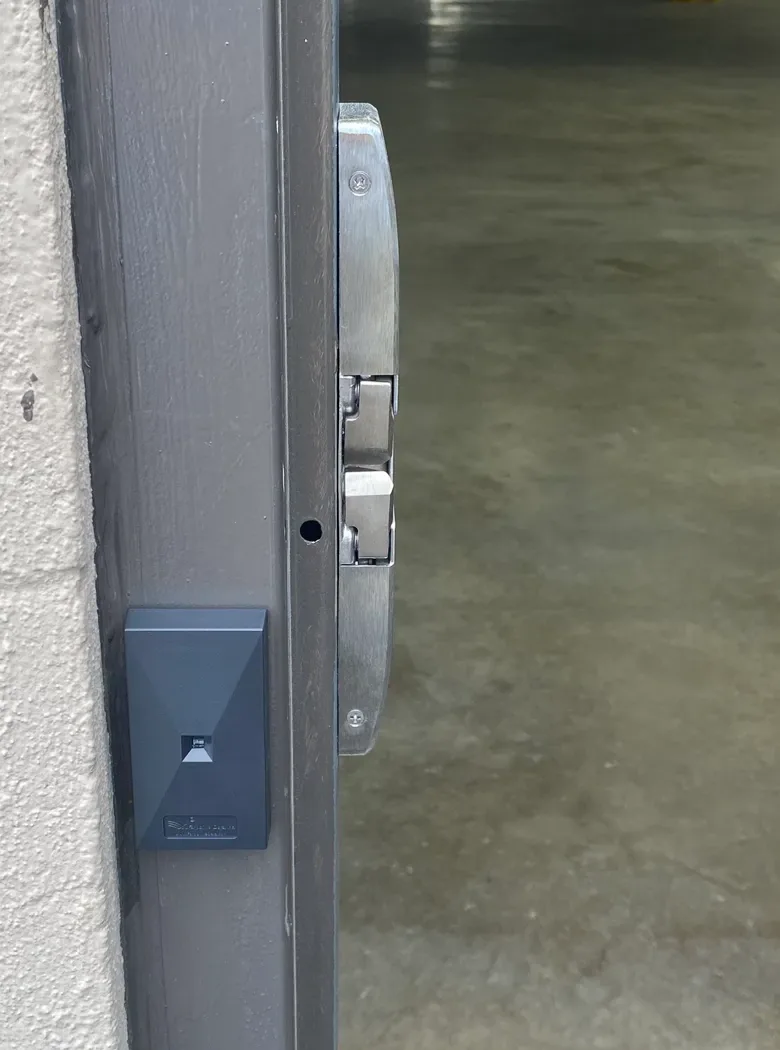
When Card Access and the Alarm Work as One System
Many commercial alarm panels, including the DMP panels we install, can run access control and intrusion detection as one system. That integration fixes problems that are hard to solve any other way:
- Arm and disarm with a badge. The first person in disarms on entry, the last person out arms on the way out. No shared code taped inside a desk drawer.
- One identity per person. Badge and alarm code belong to the same user, so removing someone who leaves the company removes both at once.
- Schedules. Doors unlock for business hours and relock automatically. The building can check itself: if it is not armed by a set time, someone gets a call.
- A single event log. "Door forced at 2:14am, motion in the warehouse at 2:15am" tells a much clearer story than two separate systems that never compare notes.
Exit Hardware on Doors You Want to Secure
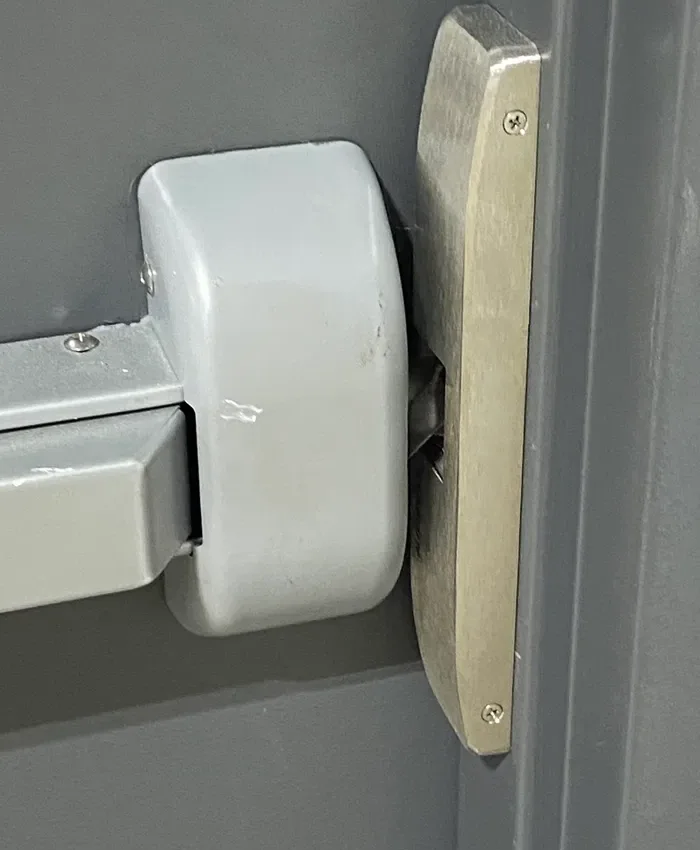
Warehouse and back doors usually carry panic hardware, and fire code requires that they open from the inside no matter what. That does not stop you from securing them. A door contact still alarms the door after hours, and adding card access usually means an electric strike or an electrified exit device that retracts the latch. Our guide to locking exit doors under NJ fire code explains which options keep free egress and which need extra approvals.
Partitions: Arm the Building in Sections
One of the most common after-hours weaknesses is a building that can only be armed all at once. If a night shift works in the warehouse, the whole building gets left off. Partitioning, or areas, divides one system into sections that arm and disarm independently:
- Offices armed at 6pm while the warehouse runs until midnight.
- A server room or cage with high-value inventory that stays armed whenever the people authorized to enter it are not there.
- A cleaning crew with codes that only disarm the areas they clean, during the hours they clean them.
Getting a Real Response
An alarm is only as good as what happens next. Central station monitoring with opening and closing reports tells you who armed and disarmed, and when. Pairing alarms with camera views lets the station verify what tripped before dispatching, which cuts false dispatches and gets a faster response when an intrusion is real. Our monitoring page explains how video verification works.
Starting From What You Have
You rarely need to rip everything out. Most upgrades start with an audit: which doors are monitored, which have position switches, where the motion detectors are and whether they are bypassed, and whether the alarm panel can integrate with access control. From there it is usually a matter of filling gaps and connecting the pieces. If your current system came from a company you no longer work with, our post on switching alarm companies covers taking it over.
We design and install integrated intrusion and access control systems for offices, warehouses, and retail in Edison, Woodbridge, New Brunswick, Piscataway, and across Middlesex, Monmouth, Union, Somerset, Essex, and Morris counties. Call 732-346-5333 or use the form below.