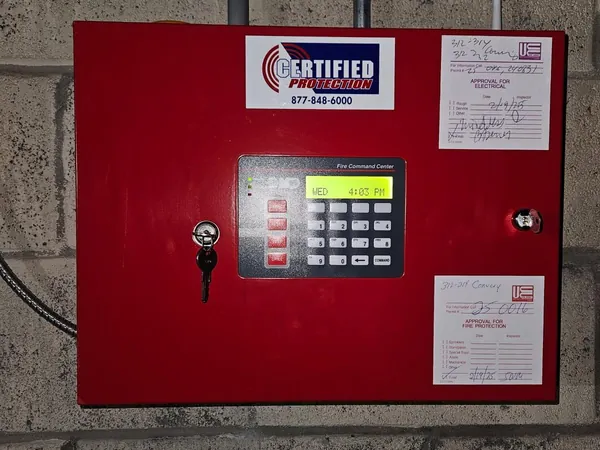
- Certified Protection installed a fire evacuation system in Woodbridge and smoke/carbon monoxide detection with 40 notification devices in Middlesex County.
- Two recent fire and life safety projects explained.
- Questions about your property? Certified Protection answers them free: 732-346-5333.
Project One: Woodbridge Fire Evacuation System
The Woodbridge project started the way most fire system upgrades start, with a fire marshal's inspection report. The building had a functional fire alarm panel and basic smoke detection, but no evacuation notification system. The existing setup could detect a fire and send a signal to the monitoring station. What it couldn't do was tell the people inside the building that they needed to leave.
That distinction matters more than most building owners realize. Detection and notification are separate systems with separate code requirements. Detection identifies smoke, heat, or flame. Notification alerts occupants through horns, strobes, speaker systems, or a combination. You can have one without the other, and plenty of older commercial buildings do, they detect but don't notify, relying on someone hearing the panel alarm and manually alerting occupants.
New Jersey fire code, aligned with NFPA 72 (National Fire Alarm and Signaling Code), requires notification appliances in commercial occupancies. The specifics depend on the building's use, occupant load, and whether it's classified as a new or existing installation. In Woodbridge, the fire marshal determined that the building's current occupancy and use required a full notification upgrade. The existing detection only system no longer met code.
What We Installed
The evacuation system included horn/strobe combination units throughout the occupied spaces, corridors, open work areas, conference rooms, and restrooms. Horn/strobes are the standard notification appliance for commercial buildings: the horn produces a temporal pattern (three pulses, pause, repeat) that's universally recognized as a fire alarm, and the strobe provides visual notification for occupants who are hearing impaired or in high noise environments.
Placement followed NFPA 72 spacing requirements, which dictate maximum distances between notification appliances based on room dimensions and ceiling height. The goal is that no matter where someone is in the building, they can both hear the horn and see a strobe. Restrooms and enclosed offices that are more than a certain distance from a corridor horn get their own appliances, a detail that's easy to miss and a common citation on inspections.
The system ties into the existing fire alarm control panel (FACP), so when any detection device triggers, smoke detector, heat detector, or manual pull station, the notification appliances activate building wide. The monitoring signal still goes to the central station, but now the occupants know about the fire before the fire department does, which is the entire point.
Project Two: Smoke & CO Detection With 40 Notification Devices
The second project, a larger commercial facility in Middlesex County, needed both detection and notification from scratch. This building was undergoing a use change, which triggered a full fire alarm system requirement where none had existed before. The scope: smoke detection, carbon monoxide detection, and 40 fire evacuation notification devices throughout the facility.
Use changes are one of the most common triggers for fire system requirements. A building that was classified as storage with minimal occupancy gets converted to office or mixed use. The occupancy classification changes, and with it, the fire code requirements. What was legal last year isn't legal now, not because the code changed, but because the building's use did.
Why Carbon Monoxide Detection Was Required
Carbon monoxide detection in commercial buildings isn't universally required, but it is in specific circumstances. New Jersey adopted requirements aligned with NFPA 720 (Standard for the Installation of Carbon Monoxide Detection and Warning Equipment) for buildings with fuel burning appliances, attached parking garages, or other CO sources. This facility had gas fired HVAC equipment, which triggered the CO detection requirement.
CO detectors are often lumped in with smoke detectors conceptually, but they're fundamentally different devices solving different problems. Smoke detectors respond to particulate matter in the air. CO detectors respond to the specific chemical presence of carbon monoxide, an odorless, colorless gas that kills occupants before they know anything is wrong. A smoke detector won't save anyone from a malfunctioning gas furnace that's producing CO instead of heat.
We placed CO detectors near the HVAC mechanical room, in the air handling zones served by gas equipment, and in occupied spaces adjacent to the parking area. Each CO detector is addressable, the fire alarm panel knows which specific detector is alarming and where, so responders don't have to search the entire building to find the source.
40 Notification Devices
The 40-device count covers the full notification layout for the building, horn/strobes in every corridor, open space, conference room, and enclosed office that meets the spacing threshold. That number isn't arbitrary; it's the mathematical result of NFPA 72's candela and decibel coverage requirements applied to this building's floor plan.
Every notification appliance is synchronized so that all strobes in the building flash at the same rate. That's not aesthetic, it's code. Unsynchronized strobes in a building can trigger photosensitive seizures in certain individuals, and NFPA 72 requires temporal synchronization across all visible notification appliances in a common area. It's one of those details that distinguishes a code compliant installation from one that will fail its acceptance test.
We had no idea the use change would trigger this level of fire system work. The fire marshal's list looked overwhelming at first, but once Certified laid out the plan and showed us what each device does and why, it made sense. Every device has a purpose, nothing is there just because.
NJ Fire Code: What Triggers a System Upgrade
Most building owners don't wake up one morning and decide to install a fire alarm system. They get told to. The triggers are predictable:
- Fire marshal inspection findings. Routine inspections or complaint driven inspections that identify deficiencies. This is what drove the Woodbridge project.
- Use or occupancy changes. Converting a building from one use to another, warehouse to office, retail to restaurant, storage to assembly. This is what drove the Middlesex County project.
- Renovation thresholds. When renovation costs exceed a certain percentage of the building's assessed value (typically 50% in NJ), the entire building may need to be brought up to current code, including fire alarm.
- Insurance requirements. Some commercial insurers require fire alarm systems, or upgrades to existing systems, as a condition of coverage. A property with a monitored fire alarm typically qualifies for reduced premiums that offset the system cost over time.
- Tenant or lender requirements. Commercial tenants (especially national chains and medical practices) and lenders may require fire alarm certification before signing a lease or closing a loan.
In all of these cases, the building owner faces the same choice: upgrade or lose the occupancy, the insurance, or the tenant. It's not optional work, it's compliance work with a hard deadline. For a broader look at what NJ commercial fire code requires, see our fire alarm code requirements guide.
What These Projects Have in Common
Despite being different buildings with different scopes, both projects shared a few characteristics that we see on virtually every commercial fire project in Middlesex County:
The existing infrastructure was behind code. Not because anyone was negligent, but because the code evolves and buildings age. What was installed 15 or 20 years ago met the requirements of that era. Today's NFPA standards require more devices, more coverage, and more documentation than they did even a decade ago.
Addressable systems made the difference. Both projects used addressable fire alarm devices, meaning every smoke detector, CO detector, pull station, and notification appliance has its own identity on the fire alarm panel. If Device 23 in Corridor B triggers, the panel says exactly that. Compare that to a conventional (zone based) system where the panel says \"Zone 3 alarm\" and a technician has to check every device in that zone. Addressable systems cost more per device but save enormous time in troubleshooting, testing, and emergency response.
The inspection process matters as much as the install. Both systems required acceptance testing by the local fire official before the buildings could receive their updated certificates of occupancy. That means every device gets tested, every smoke detector verified, every horn/strobe confirmed at the correct output, every notification circuit checked for synchronization. We schedule acceptance testing as part of the project timeline, not an afterthought, because a system that's installed but not accepted is a system that doesn't legally exist.
If you've received a fire marshal inspection report, a use change requirement, or an insurance mandate for fire system work in Woodbridge, Edison, South Plainfield, or anywhere in Middlesex County, call us at 732-346-5333. We'll review the report, walk the building, and give you a scope and timeline before anything gets signed.