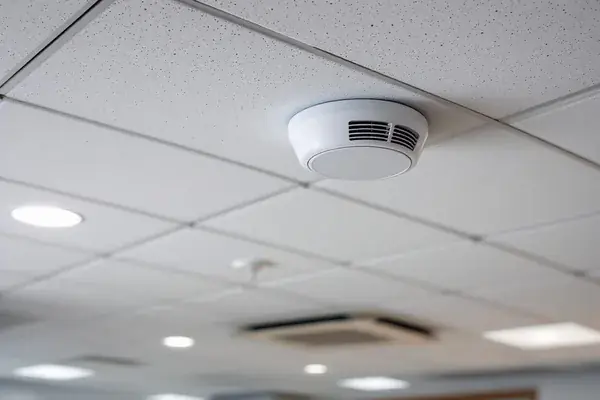
- New Jersey requires carbon monoxide alarms in one- and two-family homes, with an exemption only for buildings that have no fuel-burning device and no attached garage.
- Before you sell or re-rent a one- or two-family home, you need a compliance certificate from your local enforcing agency covering CO alarms, smoke alarms, and a kitchen fire extinguisher.
- A standalone alarm beeps. A monitored one calls someone. That difference matters most in rentals, second homes, and houses where someone lives alone. Call 732-346-5333.
What the Code Actually Says
The requirement lives in the New Jersey Uniform Fire Code at N.J.A.C. 5:70-4.19. The short version: carbon monoxide alarms are required in all dwelling units in one- and two-family and attached single-family homes. The only exemption is for buildings that contain no fuel-burning device and have no attached garage.
That exemption is narrower than people assume. A gas furnace, a gas water heater, a gas range, an oil burner, a fireplace, or a wood stove all count as fuel-burning devices. So does an attached garage with nothing in it, because the hazard is the car. All-electric house with a detached garage is about the only common case that falls outside the rule.
The specifics that catch people:
- Placement. The code calls for alarms in the immediate vicinity of the sleeping areas. It does not print a measurement, which means your local fire official's read is the one that counts. If you are unsure, ask before the inspection rather than after.
- Power source. Battery, plug-in, and hardwired are all acceptable for CO. This is different from smoke alarms, where a hardwired unit installed during construction or a rehab cannot be swapped out for a battery one.
- Listing. The alarm has to be listed and labeled to UL 2034. Any legitimate retail CO alarm will be. A combination smoke and CO unit is fine as long as it carries both listings.
- A supervised system counts. Instead of single-station alarms, you can use a CO detection system installed under the Uniform Construction Code. That is the path that ties detection into your alarm panel.
One thing the code does not spell out but every inspector knows: CO alarms expire. The sensor degrades whether or not it ever sees gas, and manufacturers print a replacement date on the unit, typically five to ten years out. An alarm from the last owner is usually past it.
The Certificate That Holds Up Closings
This is the part that turns a code question into a scheduling problem. Under N.J.A.C. 5:70-2.3, before a one- or two-family home is sold, leased, or otherwise changes occupancy, the owner has to obtain a certificate of smoke alarm, carbon monoxide alarm, and portable fire extinguisher compliance. No certificate, no clean change of occupancy.
How it works in practice:
- You apply to the local enforcing agency, usually the municipal fire official, on their form with their fee.
- They inspect, or in some cases accept a certification that the devices are installed and tested, unless a municipal code requires an actual inspection.
- They issue the certificate once the home complies.
Three details worth knowing before you schedule. The certificate is not transferable, so it belongs to that transaction. If the change of occupancy has not happened within six months, you start over with a new application. And for seasonal rentals the agency can issue one good for up to twelve months regardless of how many tenants cycle through, which matters at the shore.
The same inspection covers two other things people forget. Smoke alarms on every level and outside each sleeping area. And a portable fire extinguisher within ten feet of the kitchen, mounted on the manufacturer's bracket with the top no higher than five feet, rated at least 2A-10B:C, weighing ten pounds or less, and serviced and tagged within the past twelve months or backed by a recent purchase receipt. Landlords fail on the extinguisher tag more than anything else.
Why This Comes Up in October
Carbon monoxide is a combustion byproduct, so the risk tracks the heating season almost exactly. In October the boiler fires for the first time since spring, the fireplace gets used, space heaters come out, and the windows close for the next five months.
The usual sources in a New Jersey house are a cracked heat exchanger in a furnace, a blocked or collapsed chimney flue, a water heater that is not venting properly, a car warmed up in an attached garage, and a portable generator run too close to the house after a storm. Generators are the one that kills people after every major outage, and the mistake is almost always running one in a garage or just outside a window.
What makes CO different from fire is that there is nothing to notice. It has no color, no smell, and no taste, and the early symptoms are a headache and fatigue that read as a bad night's sleep. People go back to bed. A smoke detector does nothing here, because there is no smoke. Detection is the only warning that exists.
When a Store-Bought Alarm Is Not Enough
A ten dollar alarm from the hardware store satisfies the code and will wake up an alert adult standing next to it. That is a real benefit and we are not talking anyone out of one.
The limitation is what happens when nobody is there to hear it, or when the person who hears it is already too impaired to act. CO exposure makes people confused and sleepy, which is exactly the wrong state for deciding to evacuate. A beeping alarm in an empty house accomplishes nothing at all.
Monitored CO detection ties the detector into your alarm system. When it trips, the signal goes to the central station, and an operator calls the house, then your contact list, then dispatches the fire department. Nobody has to be awake or home for that chain to run. The situations where it earns its keep:
- Rental property. You are responsible for the building and you are not in it. A tenant who ignores a chirp is your problem.
- A second home or shore house. Empty for weeks with the heat running. Related: our guide to what actually fails in a NJ winter covers the freeze and water sensors that belong in the same visit.
- An older parent living alone. The confusion that CO causes hits hardest where the margin is already thin.
- Multi-family. One failing appliance can affect units nobody is standing in.
In most cases CO detectors add onto an existing panel wirelessly in a single visit. If you already have monitored service, you are adding devices, not starting over.
Commercial and Multi-Family Buildings
Commercial buildings are a different track. CO detection requirements come through the Uniform Construction Code and NFPA standards rather than the one- and two-family rule above, and they turn on things like fuel-burning appliances, attached parking, and how the space is used. The CO material that used to live in NFPA 720 has since been folded into NFPA 72, so your fire alarm contractor and your fire official are working from the same book for both.
For a commercial building the practical question is usually whether CO detection is integrated into the fire alarm panel and whether it is included in your inspection scope. We covered the testing cycle in how often commercial fire alarms need inspection in NJ, and we have walked buildings where CO detectors were installed years ago and never tested since.
What to Do This Month
Short list, worth an hour:
- Find every CO alarm in the house and check the date stamp on the back. Replace anything past its printed life.
- Press the test button on each one. That tests the horn, not the sensor, but a dead horn is still a dead alarm.
- Confirm there is one in the immediate vicinity of each sleeping area.
- Get the heating system serviced before you depend on it. Detection is the backstop, not the fix.
- If the house is a rental, a second home, or lived in by someone who would struggle to self-evacuate, ask about monitored CO.
We install and monitor CO and smoke detection for homes and businesses across Edison, Woodbridge, Metuchen, New Brunswick, Piscataway, and Middlesex, Monmouth, Union, Somerset, Essex, and Morris counties. Call 732-346-5333 or use the form below.